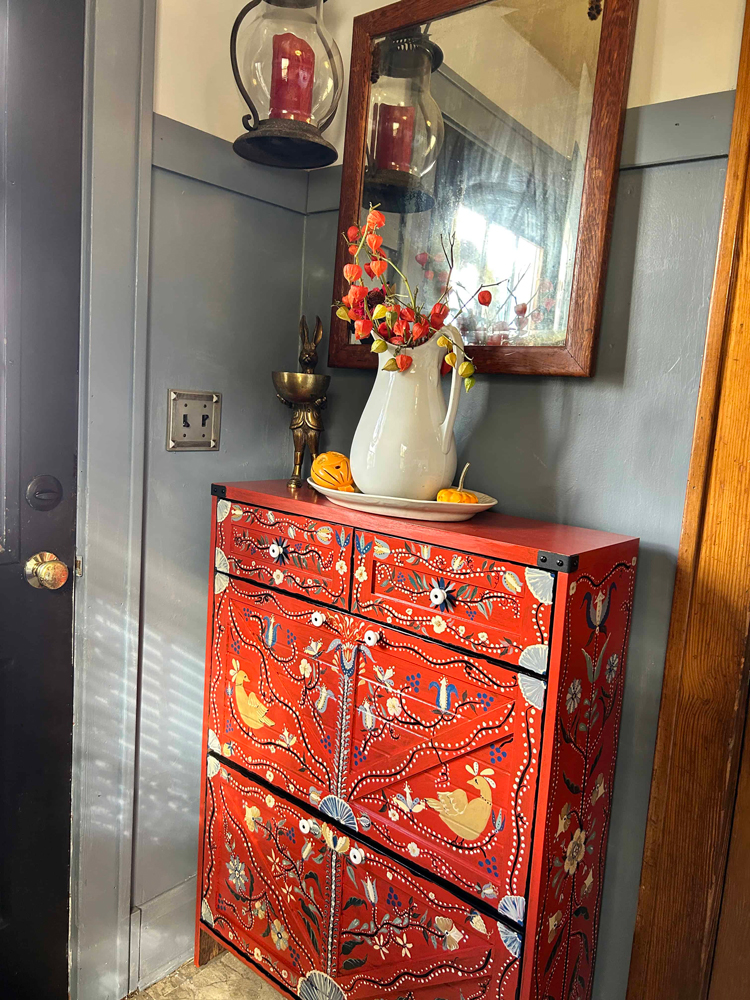

A cluttered entryway becomes a hand-painted folk art moment as a simple shoe cabinet is transformed with color, memory, and purpose. Clutter reigns supreme, and lately I’ve been trying—earnestly—to harness the chaos. Our entryway (also known as the den of chaos) has been undergoing a slow, thoughtful renovation. As the seasons shift, this space becomes a catchall for everything: campfire supplies, gardening tools, muddy boots, swimsuits, sandals, and whatever else happens to be in our hands when we walk through the door. Coming and going from my own home started to feel overwhelming, and that was my cue that something needed to change.
I hate seeing shoes everywhere—and if I’m being honest, I’m just as guilty as Bruce. We had rubber mats on the floor, which technically worked, but they didn’t solve the visual clutter. There had to be a better way. So I dove headfirst into shoe organization research. Ready, set, go.
We’ve tried cubbies in the past, but the truth is… you still see the shoes. And as gardeners, those cute little cubby holes inevitably turn into spider condos. Absolutely not. What I found instead was a slim shoe cabinet—narrow enough for our small entryway, which also doubles as our laundry room, yet spacious enough to hold both of our shoes neatly out of sight.
That’s when memory stepped in.
Growing up, my grandparents had a washstand in their entryway that my grandfather had hand-painted. It was practical, yes, but it was also beautiful. That memory stuck with me. I realized a burst of color and hand-painted charm would be ten times better than staring at a pile of shoes. Project declared. Hyperfocus fully activated.


I purchased the cheapest, ugliest color option available on Amazon, knowing it would be completely transformed. While waiting for delivery, I sketched out my vision. Once it arrived, Bruce assembled it in no time. Because it’s a laminate piece, I started with a prep paint—two coats—then followed with Chinese Red from Sherwin-Williams. I applied two light coats, allowing hints of the wood grain to show through for a weathered, antique feel. I’m not generally a fan of laminate furniture, but in this case, functionality won out over form.
Then came the design phase. I had sketched each section, but this was never meant to be perfect. This was a freeform, hand-painted folk art project. Computers are for perfection—and at almost 50, I can’t help but wonder how many things I avoided simply because they wouldn’t be flawless. These days, my philosophy is simple: who cares? Just do it.
Forty hours later, and at least three audiobooks in, it was ready for varnish. I applied three coats, knowing this is a high-traffic space in a muddy, snowy climate.
Now it sits quietly in the entryway—doing its job beautifully. And honestly? It’s 100% better than looking at shoes.